Distributed computing
In the 2000s I was into distributed computing: SETI@home, distributed.net, Seventeen or Bust and BOINC. The same interest led me to Wikipedia.

In the autumn of 1999, when I was 11, I was promised a computer. Then I accidentally flooded our flat and a couple of floors below, and after the telling-off I stopped dreaming about a computer altogether. Yet in December my father took me to the nearest computer shop, and we put together a rather expensive system. As I remember it, it was an Intel Celeron 400 MHz with 64 MB of RAM and a 17-inch Nokia monitor. By spring we had upgraded the graphics card, expanded the RAM to 128 MB and bought a 56K modem. It was classic dial-up: it tied up the phone line, was billed by the hour and cost a fortune.
SETI@home: searching for aliens
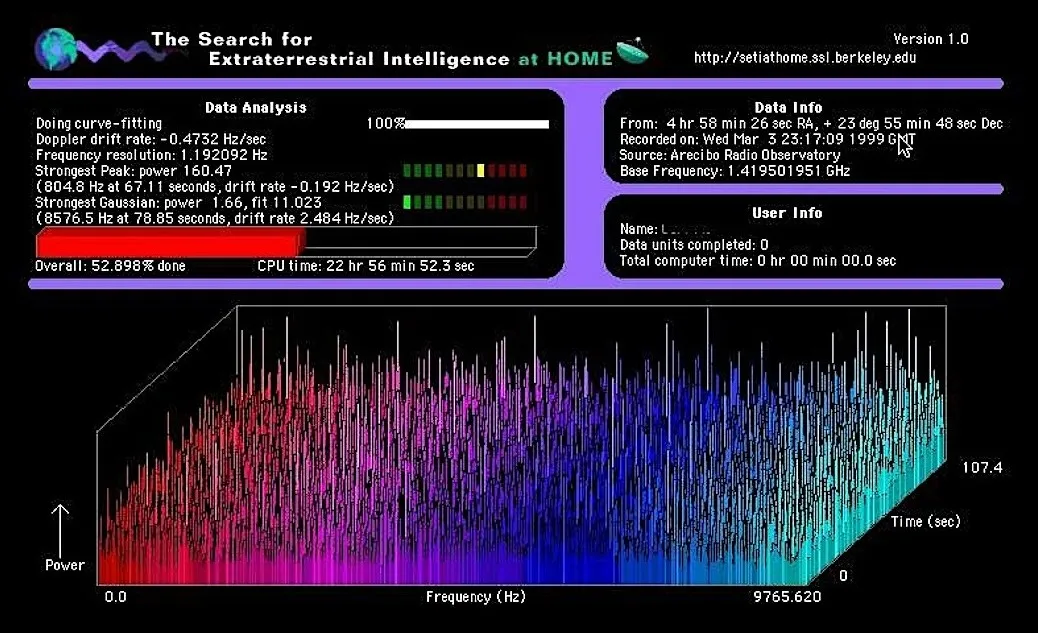
That same spring of 2000, I read in some computer magazine about distributed computing and the SETI@home science project. It had been launched at the University of California, Berkeley, in May 1999. The data came from the Arecibo radio telescope in Puerto Rico: a secondary antenna recorded the sky “piggyback” while astronomers worked on their own observations. The project listened to a 2.5 MHz band around the 1420 MHz hydrogen line, looking for “anomalies” that might point to aliens using radio. The recordings were cut into 350 KB work units, each holding 107 seconds of signal in a band of about 10 kHz. An ordinary computer took about a day to process one of them. Naturally, I soon switched to the console version of the client, which didn’t waste precious resources on graphics. I even overclocked the processor in software to 450 MHz (+12.5% performance!). The computer hummed around the clock, which drove my mother mad: she called it “cosmic farting”. In December 2002 I was 243rd of the 552 members of Team RUSSIA: 2,740 hours of CPU time, almost 19 hours per unit on average. Judging by the stats, I stopped somewhere in the spring of 2003 at 154 completed units. No signals from extraterrestrial intelligence were found :)
distributed.net: cracking ciphers
On the Russian-language internet of the early 2000s, distributed computing was quite a popular hobby. There was a site called “Distributed Computing on the Internet” (later distributed.ru), and nationwide teams called “Russia” gathered around it.
There was also the BugTraq.Ru forum, where I learned about distributed.net, a project that brute-forced cipher keys (RC5) and searched for optimal Golomb rulers (OGR). From November 2001 I took part in it as a member of BugTraq.Ru Team, one of the largest teams in the former Soviet Union. The distributed.net stats still hold a record of my work: RC5-64 from November 2001 to June 2002, OGR-25 from October 2002 to January 2004, RC5-72 from January 2003 to May 2005, and OGR-24 from January to March 2003.
Seventeen or Bust: Sierpiński numbers
In the spring of 2003 number theory joined cryptography. Since March 2002, the Seventeen or Bust project had been trying to prove that 78557 is the smallest Sierpiński number. That is the name for an odd k such that every number of the form k·2ⁿ+1 is composite. To rule out a candidate, it is enough to find a single prime of that form; by 2002, seventeen values of k were still unresolved, hence the name.
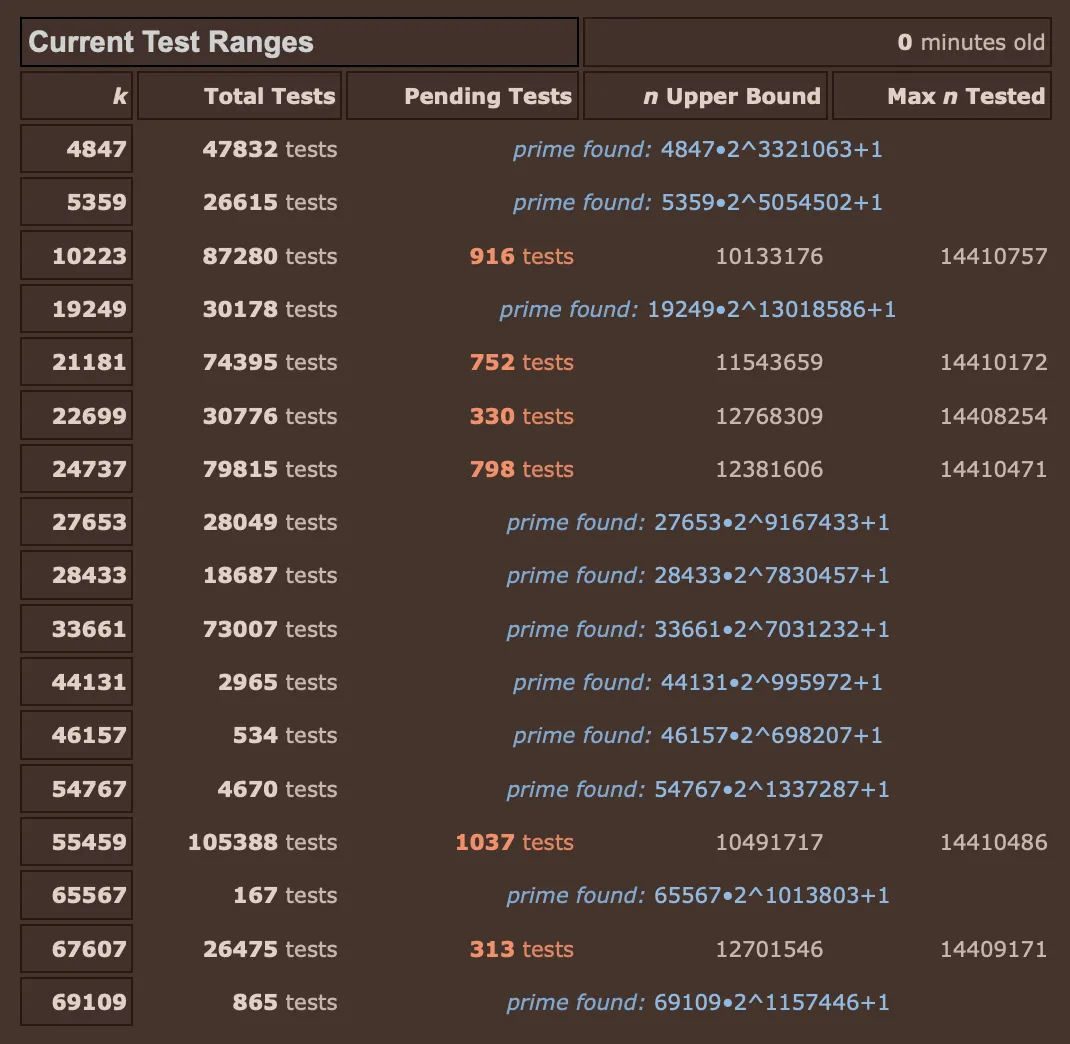
I liked their minimalist, convenient client and their nice website. I created the account gruznov at the end of May 2003 and crunched for team Russia. In February 2004 I was 31st of the 72 members of the team. When people on the BugTraq forum argued in October 2005 about where to go after OGR, I campaigned for SoB. I wrote: “The project should be finished in about two or three years, not in decades like RC5-72.” My forecast was wrong. After a brisk start, when 11 numbers were eliminated in 2002–2007, a nine-year pause followed: the next prime was found only in October 2016, and by then it was PrimeGrid that found it.
In April 2016 SoB lost its server. The backups went with it, so the participant statistics were lost for good (project history). Only fragments survive, in Internet Archive snapshots. The search was taken over by PrimeGrid: it had been running SoB as a subproject since 2010, and since 2016 it has carried on alone. Some of SoB’s old results were lost as well, and PrimeGrid kept re-checking them until October 2019. Five numbers, 21181, 22699, 24737, 55459 and 67607, remain unresolved to this day. But I had cooled on the project long before.
BOINC: from gravitational waves to proteins
My new hobby was BOINC, Berkeley’s revolutionary platform in which a single client runs tasks for many different science projects. In October 2005, a week after the BugTraq debate, I signed up for Einstein@Home, which was searching for gravitational waves in data from the LIGO detectors (LIGO itself detected the waves in September 2015, from the merger of two black holes, without Einstein@Home). After that, according to the combined stats, came SIMAP, a protein similarity database at the Technical University of Munich (I joined in December 2005, even before the project officially launched). Then Rosetta@home, a project of David Baker’s lab at the University of Washington, which predicts the shapes of proteins and designs new ones (I joined in May 2006). Next, ABC@Home, a Leiden University project that searched for “abc triples” to test the abc conjecture from number theory (I joined in January 2007, a couple of weeks after it launched). And in February 2012, after a break, came Collatz Conjecture and PrimeGrid. In PrimeGrid I ran Proth Prime Search, a search for primes of the same form k·2ⁿ+1 as in SoB, only with small k. I tried other projects too, but nothing serious.
Funnily enough, years later Nobel Prizes went to some of this research: in 2017 to the creators of LIGO, and in 2024 to David Baker, whose lab runs Rosetta@home.
On to Wikipedia
By the end of 2007 I had practically stopped taking an active part in distributed computing: at university I switched to a low-powered netbook, and I didn’t see much return from my modest contribution. Besides, a new hobby played its part: I got seriously into editing Wikipedia. And it was distributed computing that drew me into the encyclopedia. I had made my first Wikipedia edits back in December 2005, in my first year at university, but I only began editing in earnest in November 2007, when I worked on the articles about Wacław Sierpiński and BOINC and created the article “Seventeen or Bust” in the Russian Wikipedia.